

Žurnal in English
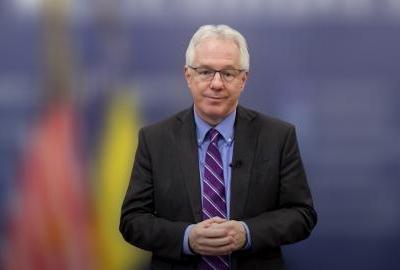
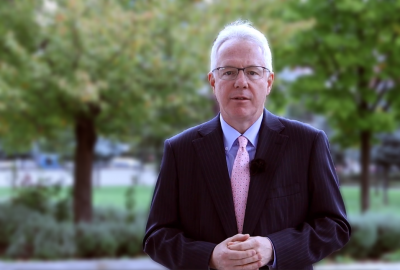
Michael Murphy exclusively for Žurnal: It would be unreasonable for Dodik to deceive President Trump
In an exclusive interview for Žurnal, the last U.S. Ambassador to Bosnia and Herzegovina, Michael Murphy, discusses the motives behind the lifting of sanctions against Dodik and others; whether and to what extent this decision by the U.S. Department of the Treasury to remove the former President of Republika Srpska entity, his associates, and companies close to the regime from the sanctions list can be interpreted as a step backward in the stabilization of political circumstances in Bosnia and Herzegovina; what kind of U.S. policy toward Bosnia and Herzegovina and the Balkans can we expect; how the geostrategic interests of Russia and China may play out in the fate of the Balkan states; and what possible consequences this may have for internal political relations in Bosnia and Herzegovina...?
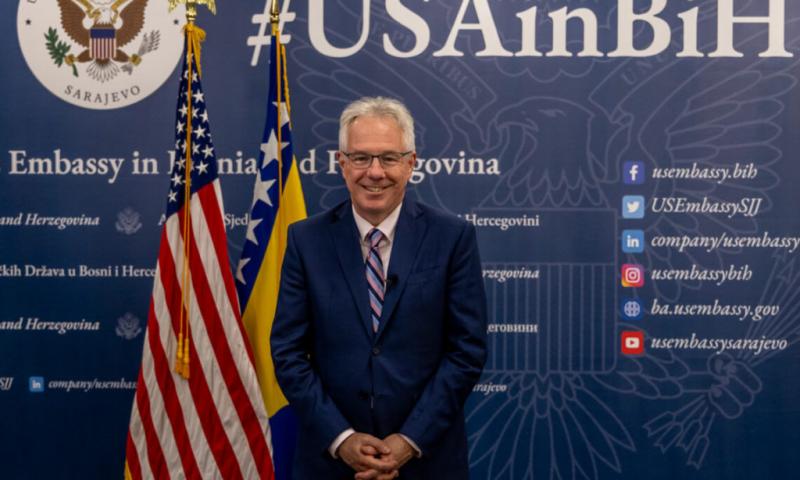
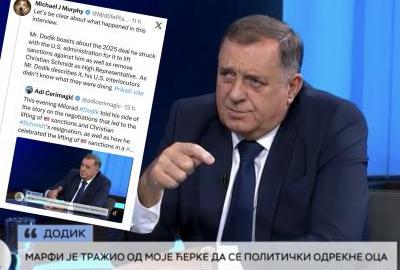
ŽURNAL: As the US Ambassador to Bosnia and Herzegovina and the US Embassy, you have been warning about the high level of corruption and abuse of power by Milorad Dodik and his political partners in power throughout almost your entire mandate. This is why the US Department of the Treasury has made decisions to suspend Dodik, his family members and political and business partners, as well as companies associated with them. These days, the same institution has lifted the imposed sanctions, explaining that this was done “due to the constructive moves made by the National Assembly of Republika Srpska in recent weeks”. These, as they say, “constructive moves by the National Assembly of Republika Srpska” are actually the annulment of their previously adopted decisions that negate the institutions of Bosnia and Herzegovina. In your opinion, what is the real reason for lifting the sanctions on Dodik and the others, because it is obvious that the reasons for imposing sanctions and the motives for lifting them are not the same?
I have no reason to believe the administration’s public explanation for lifting the sanctions is insincere. I think this administration’s efforts to leverage sanctions to secure repeal by the Republika Srpska National Assembly of anti-Dayton and unconstitutional legislation should be welcomed. There is no doubt this represented a climb down by the RS ruling coalition, whatever spin they try to put on it. The RS ruling coalition have accepted and recognized the legitimacy and authority of the Court of BiH, the Office of the State Prosecutor, and the BiH Constitutional Court, including the three international judges provided for in Bosnia and Herzegovina's constitution. On these matters, Mr. Dodik lost.
That said, there is much more work for the administration to do to advance U.S. interests in BiH, especially with regard to ensuring the RS ruling coalition respects the Dayton Peace Agreement, the state of BiH, and BiH institutions as well as respect the country's territorial integrity. The international community has a long history of making poor deals with Mr. Dodik. I first saw this when I served in BiH as Political Counselor at the U.S. embassy from 2006-2009. During that period, Mr. Dodik took advantage of a High Representative and some senior European Union officials over the Law on the Council of Ministers and on police reform, making promises he never kept in return for a relaxation of international pressure designed to hold him accountable for anti-Dayton behavior. To be fair, on police reform Mr. Dodik was ably assisted in his deception by Haris Silajdzic, but my larger point remains valid. Sadly, this pattern with Mr. Dodik has repeated itself for more than a decade with terrible consequences for Bosnia and Herzegovina.
If there is no further follow-up to hold the RS ruling coalition accountable and if Mr. Dodik continues to pursue his anti-Dayton agenda, then this new deal will fail just as past deals have. History will judge the people who made it as harshly as it has judged those who made the deals with Mr. Dodik on the Law on Council of Ministers, police reform, and other issues. That said, I do not think the Trump administration is populated by people as naïve or blind as the people who made those deals. It would be extremely unwise for the Mr. Dodik and his allies to persist in rhetoric and actions that make the Trump administration look foolish. President Trump does not like being double crossed.
ŽURNAL: To what extent did you as ambassador believe that the sanctions against Dodik and his associates contribute to stability in Bosnia and Herzegovina? Can this lifting of sanctions be interpreted as a step backwards in this regard?
Every administration I have served, including President Trump's first administration, has used sanctions as a tool for advancing its foreign policy objectives around the world. And every American administration since 1995 has used sanctions to protect and advance U.S. interests in Bosnia and Herzegovina. They were right to do so. I think sanctions remain an important tool in the American foreign policy toolkit for Bosnia and Herzegovina. It would amount to unilateral disarmament to rule out using them altogether. That would be foolish, which is why I do not think this administration will do it. It is worth reminding everyone that this administration just sanctioned Russia.
As to whether the lifting of sanctions constitutes a step backwards, I think that depends on how events unfold over the next several months, but I am not optimistic. Mr. Dodik’s rhetoric, especially his claims that he remains President of Republika Srpska and his continued calls for the rollback of reforms critical to BiH's security, stability, and functionality, do not bode well for the future. I see little evidence at this point, at least in terms of what Mr. Dodik is saying and doing, that he has abandoned his anti-Dayton agenda, but I think the administration is still in a position to change that if it is serious about holding Mr. Dodik accountable.
ŽURNAL: Your term as US Ambassador to BiH was marked by your efforts to convey the State Department's message that the activities of Milorad Dodik and the Republika Srpska regime, which are collapsing BiH institutions and advocating separatist activities, are unacceptable. Can this lifting of sanctions on Dodik and others be interpreted as a change in US policy towards BiH and the Western Balkan countries? In what direction do you expect that policy to develop?
I see no public evidence that this administration has abandoned its support for the Dayton Peace Agreement or for BiH’s territorial integrity. I think it is too early to tell whether the lifting of sanctions heralds a fundamental change in U.S. policy. It may, or it may not. It depends on what the administration does next, including whether it takes steps to hold Mr. Dodik accountable and protect the DPA, BiH, and state-level institutions.
Mr. Dodik and some of his supporters clearly believe the lifting of sanctions heralds a change in U.S. policy, but just because they say it does not make them right. They have a long history of making false claims about U.S. policy. Let me give you an example. At various times, Mr. Dodik and his supporters have implied or asserted that the United States wanted to abolish Republika Srpska or create a unitary BiH. There is not a single senior American official from any administration, including the Biden administration, that asserted either on the record as U.S. policy. Quite frankly, Mr. Dodik made all this up to frighten the people in Republika Srpska so that he can retain power and continue to enrich himself at the people’s expense. What has the RS gained from all this? It is less prosperous and less populated than it otherwise would be today, and it, like the rest of BiH, is further from EU membership, something RS residents want, than it otherwise would be.
Dead-end agendas, fueled by disinformation and founded on fear, lead to dead ends, and that is where Mr. Dodik, to date, has led the RS. There is now an opportunity for the RS to change course.
ŽURNAL: A new US ambassador in BiH has not been appointed for a long time after your departure, and BiH currently has an acting US ambassador. Is this a message from the new US administration and what kind?
The process for selecting, vetting, and confirming American ambassadors is broken, and it has been for a long time. This is a bipartisan problem, with Republicans and Democrats sharing blame. Frankly, it is embarrassing that the United States struggles to do something as basic as naming ambassadors.
I do not think you should read the failure, thus far, to nominate an ambassador to Bosnia and Herzegovina as a message from the current administration. It is simply an indication, one among many, that the United States needs to reform its nomination and confirmation process for ambassadors.
These problems notwithstanding, the recent decision to send a seasoned senior diplomat to head the U.S. Embassy as Charge d’Affaires demonstrates that the administration and the State Department retain a high level of concern for the situation in BiH.
ŽURNAL: The period of your term was marked by warnings from the State Department about the malignant influence of Russia and China on political relations in BiH, and Dodik has openly cooperated with both of them all this time. A few days before the announcement of the decision to lift the sanctions, Dodik met with the Russian political leadership for the umpteenth time. To what extent is all this one in a series of activities where broader geostrategic interests are refracted over the destinies of the Balkan states and how do you interpret it?
It is quite clear that Russia poses a security challenge to the United States and Europe, including the Western Balkans. The Trump administration has underscored more than once its unhappiness with Russia, particularly its actions in Ukraine. As I already mentioned, it recently sanctioned Russia.
I said this while I was ambassador, and it remains true now, Russia is not interested in helping the Western Balkans countries secure a peaceful, prosperous future for their citizens. The United States is. Mr. Dodik’s embrace of President Putin and his policies is self-serving and short-sighted. The people of Republika Srpska have already paid an economic price for that. If you don’t believe me, take a look at the Brod refinery and myriad other claimed Russian “investments” in the RS. What have they produced? Certainly not jobs and economic prosperity for RS residents. Where is the money?
With regard to whether the Balkan states themselves or the United States and Russia will decide the destinies of the region, I think this is a matter firmly in the hands of the Balkan countries, their political leadership, and their citizens. BiH’s political leadership, whether Bosniak, Croat, or Serb, has often blamed outsiders for BiH’s problems in order to avoid responsibility and accountability for the bad decisions they have taken. No one forced these leaders to put their political and financial interests above those they claim to represent. No one forced them to put the politics of fear and division above the shared goal of Euro-Atlantic integration. No one forced them to engage in the corruption and outright theft that plague the country. They have agency, and they alone are responsible for their rhetoric and actions. It is high time that police, prosecutors, and most importantly voters, held them responsible.
ŽURNAL: What potential consequences could this decision have for the principle of integrity and territorial unity of BiH, as envisaged by the Dayton Peace Agreement?
As I noted in response to an earlier question, it is too early to assess how the lifting of sanctions will impact BiH’s trajectory. If this turns out to be another in a long line of international community deals designed to paper over a problem without resolving it, if there is not a serious and concerted effort to enforce the deal, and if Mr. Dodik is allowed to continue to pursue his anti-Dayton, separatist agenda without consequence, then that does not bode well for BiH. I am concerned by Mr. Dodik’s recent rhetoric and claims that he remains President of Republika Srpska. He is no longer RS president, something even Russia acknowledges. But again, as I said earlier, I think it would be unwise for the RS ruling coalition to make a fool of the Trump administration. If it does, it will have only itself to blame for the consequences.
ŽURNAL: This definitely encouraged advocates of separatist ideas in BiH, openly mentioning the creation of a third entity… What are the possible consequences for domestic political relations in BiH?
The pursuit of secession or the territorial reorganization of BiH is dangerous. The U.S. has long opposed both. If U.S. or international community policy explicitly or inadvertently encourages either idea now, that could have terrible consequences for BiH. These are the simple lessons of history, nothing more. If the three principal ethnonationalist leaders in BiH continue to pursue destructive goals – separatism, third entity-ism, and unitarism – it would be grossly irresponsible. They should be pursuing policies that will lead to a peaceful, prosperous future for BiH inside the Euro-Atlantic community of nations, not the policies of the past that produced such horrible consequences for the people of BiH.
ŽURNAL: Often, in analyses of the decision to lift sanctions, there is talk of some kind of trade between Dodik and his associates with the new American administration. Do you believe in something like that? What could Dodik offer the new American administration and what could he get in return?
I am retired. I was not involved in whatever conversations took place between this administration and officials from the RS or those purportedly representing Mr. Dodik. Consequently, I do not want to speculate about what may have been said or agreed in those exchanges. Judging from the public record, the current administration expects Mr. Dodik to step away from politics altogether and the RS to end its pursuit of de facto, if not de jure, independence as well as to stop undermining the Dayton Peace Agreement, BiH, and its institutions. The actions taken October 18 by the RSNA were a positive step in the right direction, but they are insufficient by themselves. The moves by the RSNA are not “self-enforcing,” so they need to be respected and implemented by RS officials, and this implementation needs to be insisted upon by U.S. officials to secure any deal, if that is the right word, agreed to by the U.S. Let me provide two concrete examples of what I mean: the RS now must to implement BiH Constitutional Court rulings that it has thus far refused to implement, and it must appoint judges to the BiH Constitutional Court. The EU is also correct in expecting the RSNA to repeal other unconstitutional laws and conclusions.
ŽURNAL: Dodik’s lobbyists in the US, such as Rod Blagojevich and Caroline Wren, call Dodik a “Christian leader” and announce that “Serbian and Croatian Christians can hope for new autonomies in BiH”. In recent months, Dodik has conspicuously targeted politicians in Sarajevo as advocates of an Islamic Bosnia and Herzegovina, presenting himself as a Christian protector of the endangered Serbs and Croats. As someone who has spent a lot of time in Bosnia and Herzegovina, do you see Dodik in this way, and do political relations in Bosnia and Herzegovina really boil down to a conflict between Christianity and Islam? What kind of autonomy can “Serbian and Croatian Christians” expect in Bosnia and Herzegovina?
No, I do not think you can reduce relations within BiH to a “clash of civilizations” just because certain leaders wish to frame it that way or pay outsiders to do so. I do not like and have never embraced identity politics, whether in Bosnia and Herzegovina or anywhere else. When I was ambassador, I said more than once that it is a mistake to accept claims by political leaders that they are the avatars of a particular ethnic group or religion. Mr. Dodik is not representative of all Serbs or Orthodox Christians any more than Mr. Covic is representative of all Croats or all Catholics, or Mr. Izetbegovic is representative of all Bosniaks or all Muslims. These leaders claim otherwise to shield themselves from accountability and distract voters from decisions that put their political and financial interests above those of their constituents. My experience with the public in BiH was exactly the opposite. The people of BiH are not full of the hate that you all too often hear in the rhetoric from the country’s political leaders. They are good people who want better lives for themselves, their children, and grandchildren. They deserve leaders who will deliver that for them.
ŽURNAL: To what extent does such a narrative about “Christian protectors” and “aggressive Islamists” really contribute to greater support for Dodik by the new US administration, and probably also for Čović?
As I noted in response to an earlier question, I was not involved in any of the current administration’s internal discussions about U.S. policy towards Bosnia and Herzegovina. So, I am not in a position to assess what factors influenced or influence the Trump administration’s decision making. As you noted in your earlier question, it is certainly true that people outside the administration are making arguments about BiH based upon a “clash of civilizations” world view. As I said, I do not think this reflects reality within BiH. At best, it reflects a self-serving and destructive narrative offered by some of the country’s political leaders. More hate and division is not going to secure a peaceful, prosperous future for BiH and its people; nor will it secure the United States’ core strategic interest in the country or region – the preservation of Bosnia and Herzegovina’s territorial integrity.
ŽURNAL: During your term as ambassador to Bosnia and Herzegovina, you often suffered vulgar insults from Dodik and his close associates, although some politicians from Sarajevo were not far behind. How does all this affect you personally, since you are, after all, the only one tasked with implementing the policy of your country?
That kind of thing comes with the job. You need to have a thick skin to serve as an ambassador, and I never let the insults from Mr. Dodik or anyone else bother me. Frankly, when BiH political leaders chose to respond to our presentation of the facts with insults or falsehoods, it told me we were hitting the mark and doing our jobs right. During my time in Bosnia and Herzegovina, the embassy and I never conflated the country’s political leaders with its people. We were critical of Mr. Dodik, Mr. Covic, Mr. Izetbegovic, and others when it was warranted. Our criticisms were substantive, not personal. We never, ever criticized or attacked Bosniaks, Croats, Serbs, or citizens as a group. My experience is that the people of BiH are good people, who want what people everywhere want: a peaceful, prosperous, and democratic futures for themselves, their children, and their grandchildren. The rhetoric, behavior, and corruption from the country’s political leaders which put that future at risk reflect badly on the leaders themselves, not the people of BiH.
ŽURNAL: The departure of Christian Schmidt, who, together with you, was often targeted by Dodik and his supporters, has been announced these days, and the possible closure of the OHR is also being mentioned. How, in your opinion, could such a decision affect Bosnia and Herzegovina and stability in the region?
In 2008, when the 5+2 agenda was set for the closure of OHR, something I worked on, the international community thought it would be relatively easy for BiH to fulfill that agenda. We thought OHR would close within a matter of a few years. That did not happen because political leaders made the decision to pursue destructive ethnonationalist agendas rather than work together to build a better future for the people of BiH. In retrospect, the international community should have anticipated this, or at least responded early on when it was clear things were not working the way we had expected.
Quite frankly, I think it was a mistake for the international community to step back from its leadership role in BiH after 2008. We also placed much too much faith in the transformative power of the EU accession process. I can understand why. It and NATO enlargement had produced stunningly positive results for many countries in Europe, but Poland and Czechia are not Bosnia and Herzegovina. The EU failed to recognize this, so it did not adjust its approach to political realities in BiH. Worse, on more than one occasion, deals were made with the country’s ethnonationalist political leaders which made matters worse and then were heralded as “progress.” The United States, particularly during the Obama administration, engaged in the same self-deception because this dovetailed with its goal of reducing the U.S. role in BiH and the Western Balkans.
There was a period in BiH’s history, a decade or so, when it was effectively without a High Representative. This was not the High Representative’s fault. This was a deliberate reflection of the international community’s strategy for this period, which I just outlined. It did not work so well. It is unfortunate, but we have learned or should have learned, that in order to do the job Annex 10 charges him with, the High Representative will often need to act. This is unfortunate, but it is where we are because of the rhetoric and actions of local political leaders. Action by the High Representative is going to make people unhappy, especially ethnonationalists, but again, that comes with the job. Sometimes it will make parts of the international community unhappy.
But here’s the thing, the High Representative does not exist to do the bidding of one ethnic group or members of the PIC. It was never the High Representative’s job to create a “civic state,” whatever that term might mean, and the High Representative cannot amend the Dayton Constitution. The High Representative’s job is to implement the Dayton Peace Agreement and to defend BiH and its institutions. If the feeling today within the international community is that this is no longer necessary, that the High Representative should sit in his office and do nothing, or that he should not use the Bonn Powers other than as “a last resort,” a phrase that has always meant “never,” then the international community should go ahead and close OHR after OHR does what it needs to do to ensure that the 5+2 agenda is met. We do not need another decade of self-delusion within the international community about its BiH policy.
ŽURNAL: After leaving BiH, did the new US administration contact you and ask for your opinion on political relations in BiH?
No, I retired after returning to the United States. I knew my time as ambassador would come to close in February 2022, and after completing my time in BiH and 34 years of service with the Department of State, I was ready to start a new chapter in my life.
ŽURNAL: What is the position of other politicians in the US on the situation in BiH and this decision to lift sanctions?
It is not my place to speak for other U.S. politicians about their views on the situation in BiH or the administration’s decision to lift sanctions. They can speak for themselves, and some of them have. I note that Senator Shaheen has offered her views about all this, and she is a strong friend of your country.
ŽURNAL: In your opinion, what should be the next strategies for the US and Western partners in BiH in order to ensure long-term commitment to the principles of democracy, the rule of law and the fight against corruption in the entities and state institutions?
I think it is important to start with BiH political realities as they are, not as policymakers would like them to be. And this needs to be married to a carefully considered view of national interests. If you believe, as I do, that America has an interest in preserving BiH’s territorial integrity and you also have a clear-eyed understanding of realities on the ground, a good policy should flow naturally from that, including how you approach the rhetoric and actions of BiH’s ethnonationalist political leaders. You may want local solutions or local ownership, which is understandable and certainly should be the objective, but left unchecked or unchanneled, ethnonationalist local ownership is not going to produce outcomes consistent with the West’s interests. And let’s be really frank here, understanding the realities on the ground also means understanding what is not possible in BiH, certainly now and for the foreseeable future. It is unrealistic to ask people to abandon their ethnic identities or to treat as unreasonable the fears of people concerned about losing them or the protections enshrined for them in the Dayton Peace Agreement. BiH is a wonderful country with a rich multiethnic tradition, which is something to embrace, but that history is also complicated and fraught. Separation, division, and endless blockades are not answers to the political challenge this presents, but neither is unitarism or unalloyed majority rule.
(zurnal.info)